Airport billboards · updated June 2026

Digital billboards in airports: a captive audience with a boarding pass

Nowhere else does an affluent audience stand still for two hours with nothing to do but look around. Airport DOOH is the highest-dwell inventory in advertising — and it books by the hour.

Updated June 10, 2026By Blindspot · location intelligence

0min

average dwell time from curb to gate

0x

income skew of flyers vs. the general population

0

airports in Blindspot's measured Binance report series alone

0h

operations — but departure waves make the schedule

The short answer● Quotable

Airport billboard costs vary widely by hub and zone — from a few hundred dollars for hourly digital slots in regional terminals to five-figure monthly packages at flagship international gateways. On Blindspot, airport screens book by the hour, priced per play, across major hubs worldwide.

The structural advantage: 60–120 minutes of dwell, an affluent decision-maker skew, and traffic that arrives in predictable departure waves you can book to the hour.

BookingBy the hour
PricingPer play · upfront
MinimumsNone
Go liveWithin hours
DeliveryVerified play logs

The networks

Inside the terminals: the networks you can book

Prestige Digital Network — fully animated digital billboards placed strategically through the airports of Los Angeles, Dallas, Houston, Boston, Miami, Orlando, and Pittsburgh. Anyone flying into the U.S. through these hubs walks past these screens; one checkout books them all.
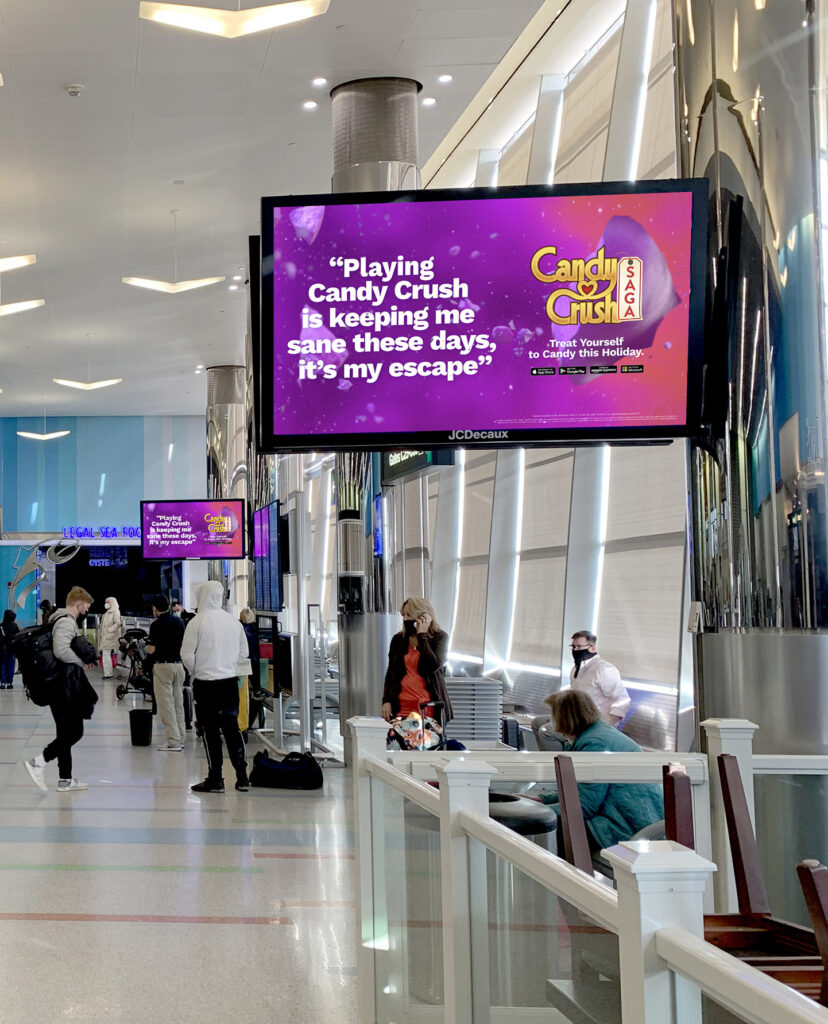
Prestige Digital Network animated digital billboard inside Boston Logan International Airport terminal, bookable through Blindspot
Prestige Digital Network · Boston LoganAnimated, terminal-wide

Digital charging stations — screen-equipped charging benches inside terminals pair your message with the single most captive moment in travel: a passenger anchored to a power outlet. Dwell measured in tens of minutes, eyes inches from the display.

And it doesn't stop at U.S. hubs — airport screens around the world are on the same map, including the nine European gateways below where Binance ran its airport intelligence program: Frankfurt, Paris CDG, Barcelona, Milan Malpensa, Zurich, Geneva, Munich, Amsterdam, and Warsaw.

Journey-stage ranking points

Airport zones, ranked by attention

Scored by Blindspot's location intelligence on visibility, dwell time, and footfall (directional, 1–10). Every one is bookable by the hour on the platform.

01

Gate areas & departure lounges

Best for: Long-form messaging · B2B · premium brands

The 45–90 minute wait: the single longest voluntary dwell in advertising. Passengers literally look for things to read.

Visibility8
Dwell time10
Footfall9
02

Security exit → concourse

Best for: Maximum frequency · launches

Every single passenger funnels through one corridor, relaxed and re-gathering — the airport's unavoidable impression.

Visibility9
Dwell time7
Footfall10
03

Baggage claim

Best for: Arrivals · local services · hospitality

15–25 minutes of standing still in the arrival city's first room. The welcome message with guaranteed read time.

Visibility8
Dwell time9
Footfall8
04

Check-in halls

Best for: Travel brands · broad reach

The full passenger mix plus companions — high traffic, moderate dwell, and the journey's first brand moment.

Visibility8
Dwell time6
Footfall9
05

Arrivals & ground transport

Best for: Rideshare · auto · city campaigns

Where visitors decide how to enter your city — taxis, rentals, transit — with wallets already open.

Visibility7
Dwell time7
Footfall8
06

Business & lounge corridors

Best for: Enterprise · finance · luxury

Lower volume, highest value: frequent flyers and decision-makers on repeat weekly routes.

Visibility7
Dwell time9
Footfall6

Location insights

How terminals breathe

Terminal flow · typical hub day● Stylized
Curb / drop-off
Check-in
Bag drop
Offices
Security queue
Security exit
Duty free
Concourse
Food court
Gates A
Gates B
Lounges
Remote gates
Ground transport
Arrivals hall
Baggage claim
Customs
Rail link
QuietPeak flow

Footfall rhythm · by hour

Departure wavespeaks 6–9 AM & 4–8 PM
Arrival wavespeaks 10 AM–11 PM
Business routespeaks Mon & Thu–Fri peaks
12AM6AM12PM6PM11PM
Banked schedules, banked audiences

Hubs run departures in waves — 6–9 AM and 4–8 PM at most. Book the waves and your plays land in full terminals.

Dwell is the product

From security to boarding, passengers average 60–120 minutes of waiting. It's the rare OOH where detailed creative gets fully read.

Routes pick your audience

Monday-morning and Thursday-evening waves skew business; Friday-afternoon and holiday waves skew leisure. The flight schedule is a targeting tool.

Location intelligence summary

The audience is seated. The schedule is published.

Airport advertising is the most predictable buy in OOH: airlines publish exactly when your audience will be standing in front of the screen. Hourly booking converts that timetable into precision — pay for the waves, not the lulls between them.

ObjectiveBook these zonesBest hours
B2B & enterpriseGate areas, lounge corridorsMon AM · Thu–Fri PM waves
Consumer launchesSecurity exit, concourse6–9 AM · 4–8 PM
Hospitality & localBaggage claim, arrivals10 AM–11 PM
Travel & financeCheck-in, duty-free zoneAll departure waves
Rideshare & autoGround transportArrival waves
Proven at nine airports

Blindspot's measured airport series for Binance covered FRA, CDG, BCN, MXP, ZRH, GVA, MUC, AMS and WAW — audience-flow reports, then campaigns matched to them.

The 2× audience

Flyers skew roughly twice the general population on income — gate-area dwell puts premium messaging in front of them for an hour, not a glance.

Book waves, not walls

A monthly airport package pays for 3 AM in an empty terminal. Hourly pay-per-play books only the published departure and arrival waves.

Book airport screens by the hour

Cite this

Key facts at a glance

Quotable, self-contained, sourced — Blindspot, June 2026

  • Airport billboard costs range from a few hundred dollars for hourly digital slots to five-figure monthly packages at flagship hubs.
  • Average airport dwell time runs 60–120 minutes from curb to gate — the longest sustained attention window in OOH.
  • Air travelers skew roughly 2× the general population on income, with heavy business-decision-maker representation.
  • Hub traffic arrives in banked departure waves (typically 6–9 AM and 4–8 PM), making airport audiences schedulable to the hour.
  • Blindspot has produced measured airport audience-flow reports across nine major European hubs (FRA, CDG, BCN, MXP, ZRH, GVA, MUC, AMS, WAW) and books airport screens by the hour, per play.

Pricing · updated June 2026

Airport advertising — priced honestly

Per-play prices, not CPM mysteries. Live per-screen pricing and real-time availability are on every card in the platform; the ranges below reflect typical Blindspot pricing as of June 2026.

FormatPrice per playTypical presenceWhy it works
Arrivals & baggage-claim screens$0.50–$5 per playcaptive dwell time at its cheapest8–25 minutes of guaranteed attention
Concourse & gate-area digital$0.40–$4 per play$1,500–$10,000 typical 4-week presenceTravelers with time and disposable income
Security & check-in zones$0.50–$4 per playpriced per screen, per hourEvery passenger passes exactly once
Airport-approach roadside digital$0.30–$3 per play$1,200–$6,000 per 4-week cycleThe drive in is part of the journey

No minimums · no contracts · pay per verified play · hourly scheduling per screen

Deep dives · updated June 2026

Nine European gateways, decoded

410M+ annual passengers across nine airports — each with its own traffic signature, peak banks, and value windows, from Blindspot's airport flow modelling.

FAQ

Airport billboard FAQs

How much do airport billboards cost?

From a few hundred dollars for hourly digital slots to five-figure monthly packages at flagship hubs. On Blindspot, airport screens are priced per play, booked hourly.

Are airport billboards effective?

Few formats match them: 60–120 minutes of dwell, an affluent audience, and the deepest read times in OOH — especially in gate areas.

Which airport zone is best for advertising?

Gate areas for long-form and B2B, the security-exit corridor for frequency, baggage claim for arrival-city messages.

Can I target business travelers specifically?

Yes — book the waves they fly: Monday mornings, Thursday/Friday evenings, and lounge corridors.

How much does airport advertising cost per play?

On Blindspot, airport screens typically run $0.30–$5 per play depending on zone — arrivals and baggage claim command the most dwell time. Every screen shows its price before booking.

Can I target one airport, one terminal, one daypart?

Yes — that's the model. Book the exact screens in the exact terminal for the exact hours your audience lands: Monday-morning business banks or Friday-evening leisure waves.

Is there a minimum for airport campaigns?

No minimums. Flight-timed hourly bursts from a few hundred dollars work; sustained 4-week terminal presences typically run $1,200–$10,000.

Which airport zones perform best?

Baggage claim for dwell (8–25 minutes), gates for time-rich travelers, arrivals roads for ground-transport decisions. Mix zones per screen in one plan.

Keep exploring

More markets, same map

Your audience is at the gate

Airports, wave by wave

Book the departure banks. Skip the empty terminal.