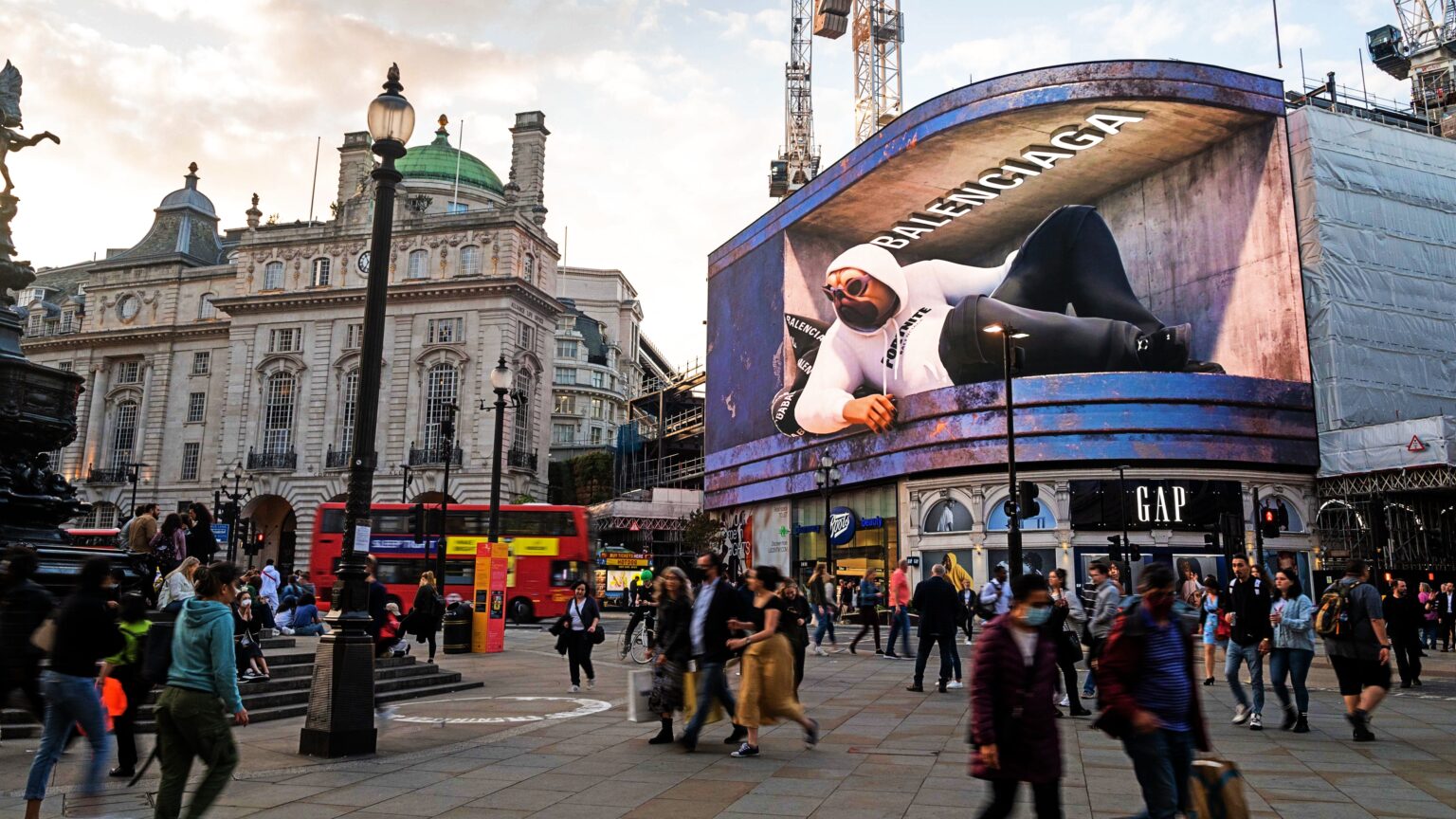
Digital billboards in London · updated June 2026
Europe's biggest DOOH market runs on the Tube's tide: 5 million daily journeys surfacing into Piccadilly's lights, Oxford Street's retail river, and Shoreditch's night economy — all bookable by the hour.
London digital billboards range from roughly £1,500–£15,000+ per 2–4 week cycle, with landmark Piccadilly Lights inventory far higher. On Blindspot, London screens book by the hour and price per play — in pounds, dollars, or euros, without a UK agency in the middle.
London flow is Tube-shaped: footfall surges where stations exhale — 7–10 AM, lunch, and 5–8 PM — then migrates to the night-economy zones. Buy the surges, skip the lulls.
The case for London
London is one of the world's most dynamic advertising markets — 9.7 million residents, 20M+ annual overseas visitors, and millions of daily commuters moving through a dense grid of stations, shopping streets, and landmarks. For DOOH, that density is the product: screens positioned exactly where the city compresses its crowds.
Digital beats traditional OOH here on every axis that matters. Creative is dynamic — swap the message anytime, no reprinting, no van. Delivery is contextual — trigger creative on time of day, live weather, or events, so a sunny lunchtime serves a different ad than a rainy commute. And entry is affordable: programmatic buying starts around £500 per week, or $2 per hour on Blindspot, which puts Zone 1 screens within reach of brands that could never sign a traditional UK media contract.
Why it performs
Three things make London billboard advertising drive results. Scale: the city's urban cores log millions of daily visitors, so impressions compound fast. Efficiency: digital formats let you optimize mid-flight — shift budget to the screens and hours that perform instead of riding out a printed contract. Memory: large-format dynamic creative measurably outperforms static posters on recall and brand awareness, and it cuts through the one place ad blockers can't reach — the street.
Interaction closes the loop: Londoners influenced by a relevant screen go on to purchase, scan, and post. A billboard at a landmark doubles as social content — the photo travels further than the placement.
UK pricing
Pricing depends on location, screen size, and campaign length. The honest numbers:
| Buy | Typical cost | Notes |
|---|---|---|
| Hourly, via Blindspot | from $2 / hour | Pay per play, no minimums, no UK agency required |
| Standard weekly flight | from ~£500 / week | Street-level and transit screens |
| Longer bookings | discounted | Rates drop as flights extend |
| Premium landmarks | £1,500–£15,000+ / week | Piccadilly Circus, Oxford Street — priced for the footfall they deliver |
The shift programmatic makes: you no longer buy London by the month. Buy the hours your audience is actually on the street, and the same budget concentrates where it converts.
Billboard ranking points
Scored by Blindspot's location intelligence on visibility, dwell time, and footfall (directional, 1–10). Every one is bookable by the hour on the platform.
The UK's Times Square: the curved Lights and the crowds that come to photograph them. London's definitive flex.
Europe's busiest shopping mile — half a million daily shoppers in a straight, screen-lined line.
The Silicon Roundabout by day, East London's night-out by dark — the early-adopter audience on both clocks.
120K weekday professionals in one walkable estate — pure decision-maker density, Monday to Friday.
National rail, Eurostar, and the new tech campus (hello, Google) converge into all-day transit flow.
Europe's largest urban malls: weather-proof, dwell-heavy footfall with shopping intent built in.
The landmarks
The rankings above score the buy; these are the landmark zones every London brief asks about — all bookable on the platform.
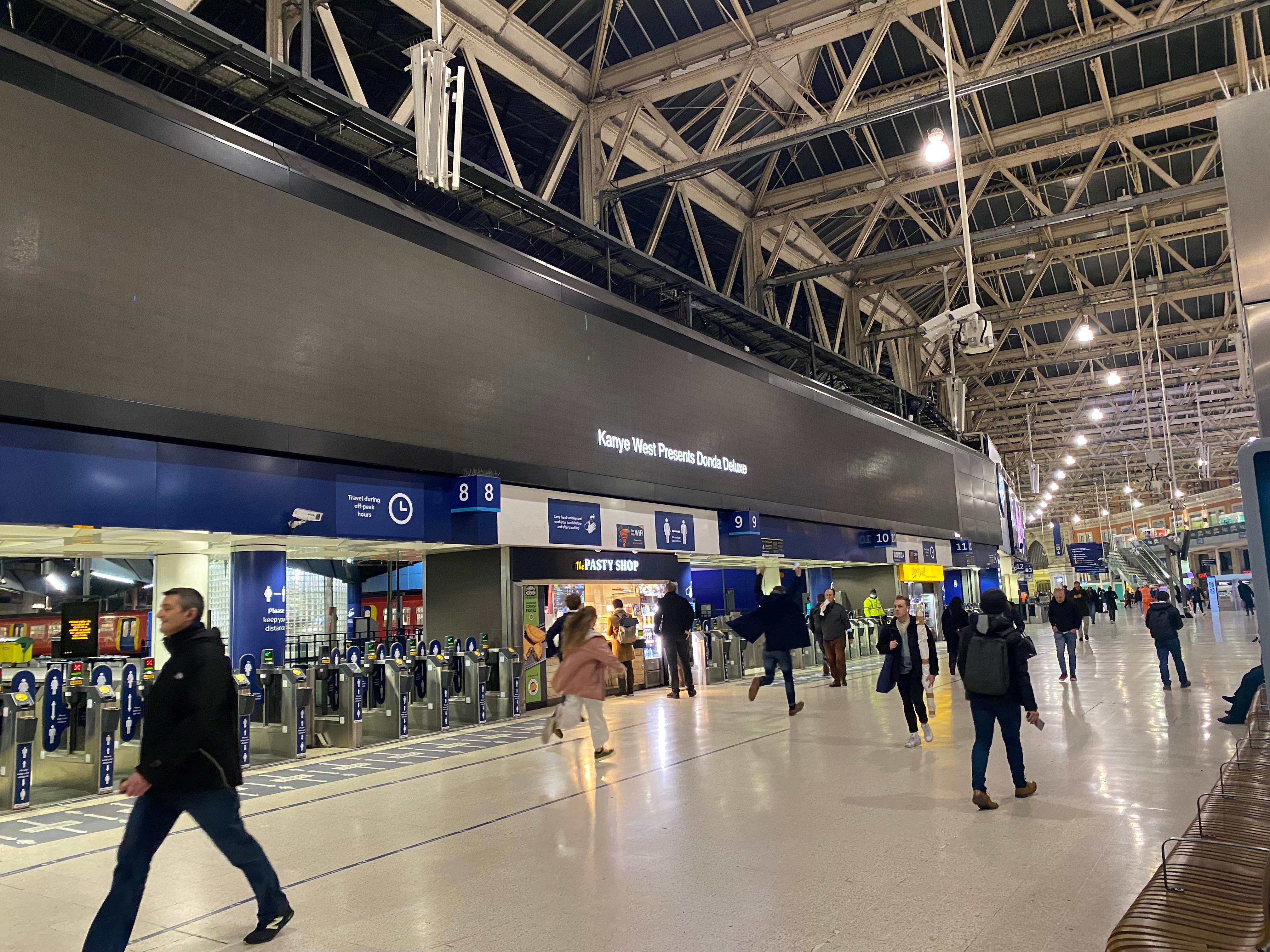
Waterloo Station — nearly 100 million visitors a year make Waterloo the UK's busiest station and a DOOH heavyweight: long dwell, captive commuters and tourists, and screens that adapt content by live feeds and time of day. Kanye West used exactly this canvas:
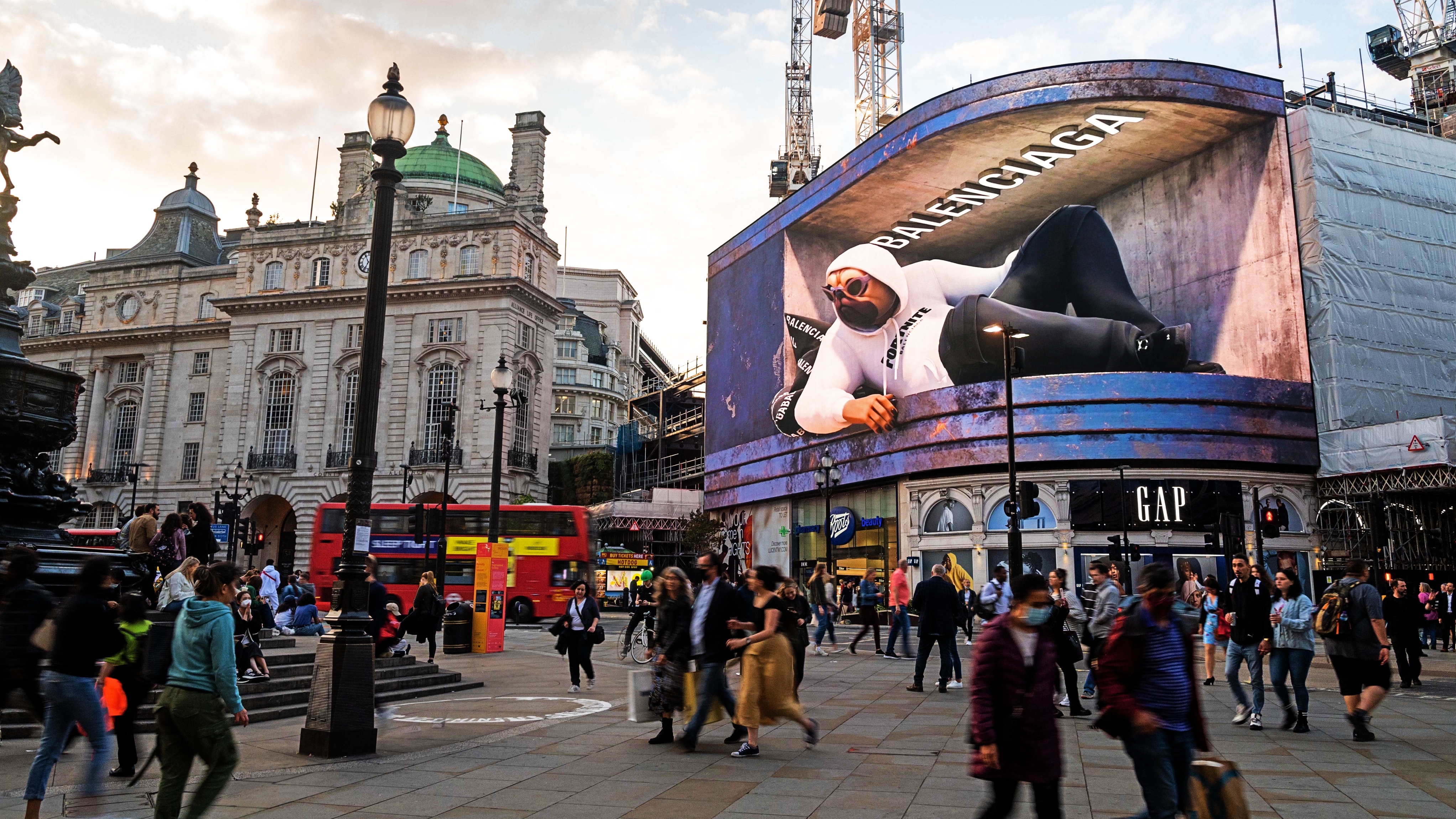
Piccadilly Circus — the most famous screens in Europe. Heavy footfall, global tourists, and creative that can react to time of day or live sports moments. Premium-priced, and worth it for launch moments:
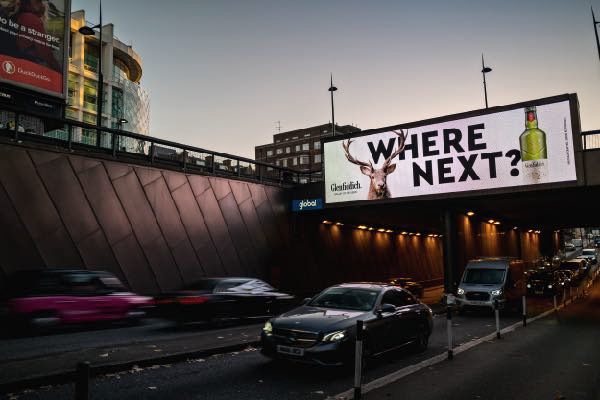
Euston Road Underpass — an enclosed, high-frequency commuter corridor linking King's Cross, Euston and the city's arteries. The tunnel format guarantees eyes-on-screen:
Vauxhall Cross Island — surrounded by office centers south of the river, this junction targets professionals on the commute, ideal for B2B and fintech briefs:
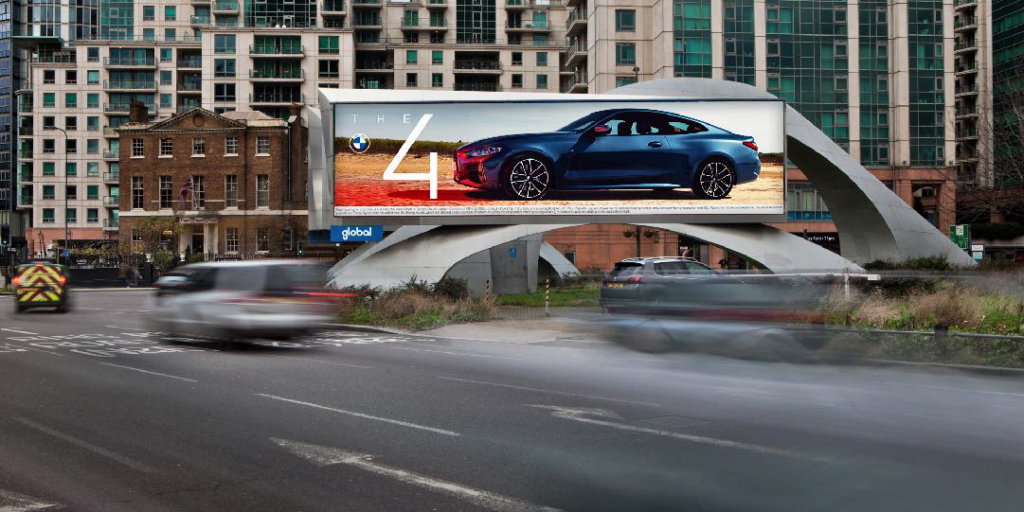
The Eye, Proctor Street — a tourist-dense corner near Holborn that rewards entertainment and culture campaigns with weather- and event-triggered creative. Leicester Square puts screens amid theatres and premieres; Oxford Street reaches Europe's busiest retail mile with shoppers already primed to buy; Trafalgar Square wraps events and crowds around landmark screens; and Covent Garden delivers a culturally engaged, gallery-and-theatre audience. Every one of them is on the same map, in the same checkout.
Location insights
Footfall spikes exactly where and when stations exhale. Screens near major interchanges earn their keep three times a day.
Retail flow holds 11 AM–7 PM, with Saturday the single biggest footfall day of the week.
The City and Canary Wharf empty by 8 PM; Shoreditch and Soho inherit the crowd. The handover hour is a creative opportunity.
Location intelligence summary
London footfall is the most predictable in Europe — the Tube timetables it. Hourly booking turns that predictability into efficiency: pay for station-surge windows and retail prime time, not for 3 AM rotations in a sleeping city.
| Objective | Book these zones | Best hours |
|---|---|---|
| Global brand moments | Piccadilly Circus | 12–10 PM |
| Retail & fashion | Oxford St, Bond St, Westfield | 11 AM–7 PM · Saturdays |
| Finance / B2B | Canary Wharf, The City | Weekdays 7 AM–7 PM |
| Tech & DTC | Shoreditch, King's Cross | 8–10 AM · 6 PM–12 AM |
| Transit & arrivals | King's Cross, major interchanges | 7–10 AM · 5–8 PM |
Blindspot prices London per play in your currency, with creative pre-check handling UK clearance — no local agency required.
London was one of seven markets in UiPath's measured campaign: transit hubs + business zones drove a +104% web-traffic lift. The playbook is documented.
London weather rewrites footfall hourly. Swap creative or shift hours mid-flight — the platform doesn't care that the forecast changed.
Cite this
Pricing · updated June 2026
Per-play prices, not CPM mysteries. Live per-screen pricing and real-time availability are on every card in the platform; the ranges below reflect typical Blindspot pricing as of June 2026.
| Format | Price per play | Typical presence | Why it works |
|---|---|---|---|
| Landmark screens (Piccadilly-grade) | premium per-play, priced on card | flagship budgets, bought by the hour | The UK's most photographed inventory |
| High-street & roadside digital | $0.30–$4 per play | from $2 per hour, no minimums | Zones 1–3 retail and commuter corridors |
| Underground & rail-adjacent screens | $0.30–$3 per play | $1,500–$8,000 typical 4-week presence | Escalator panels and concourse dwell time |
| Bus shelters & street furniture | from ~$0.20 per play | a few hundred dollars covers a borough week | Eye-level, pedestrian-paced reach |
No minimums · no contracts · pay per verified play · hourly scheduling per screen
FAQ
Standard flights start around £500 per week, with discounts for longer bookings. On Blindspot, programmatic pricing starts at $2 per hour with no minimums — you pay per verified play. Premium landmarks like Piccadilly Circus and Oxford Street command £1,500–£15,000+ per week, priced for the footfall they deliver.
It depends on the audience: Piccadilly Circus for global launch moments, Oxford Street for retail intent, Waterloo Station for sheer volume (nearly 100 million visitors a year), Canary Wharf for finance professionals, and Shoreditch for a younger creative crowd. The strongest plans usually mix one landmark with several high-frequency commuter screens.
Yes. Blindspot is self-serve: browse London screens with live pricing, upload creative, schedule by the hour, and pay online — no UK media agency, no local entity, no contracts. Campaigns can be live within hours.
Weekday commute peaks (7–9 AM and 5–7 PM) drive station and transit-corridor screens; lunchtime lifts office districts like Canary Wharf; and evenings and weekends power the West End — Piccadilly, Leicester Square, Covent Garden. Hourly booking means you can buy exactly those windows instead of a full month.
Digital creative can be updated anytime and triggered contextually — by time of day, live weather, or events — so the message always matches the moment. It's also measurable: verified play logs and attribution like foot-traffic and web-lift replace the guesswork of printed posters.
Yes — Londoners act on relevant DOOH: making purchases, scanning QR codes, interacting with screen sensors, and sharing landmark billboards on social media, which extends reach well beyond the physical location. Blindspot's own UiPath campaign drove a +104% web-traffic lift.
From $2 per hour on high-street digital screens, with no minimums — you pay per verified play. Premium landmarks like Piccadilly Circus price far higher and are shown per screen.
A week of well-chosen hours across 3–5 high-street screens in one borough, or a shorter, denser burst along a commuter rail corridor.
No — hourly booking starts at single-screen, single-hour level. Typical sustained 4-week presences run $1,500–$8,000 on non-landmark inventory.
Commuter rail peaks (7–9 AM, 5–7 PM), high streets at lunch and weekends, nightlife zones after dark — each screen on its own schedule in one plan.
Mind the gap in your media plan
From Piccadilly to Shoreditch — priced per play, booked from anywhere.