Blinky · AI media planner · updated June 2026

The AI that plans, books, and babysits your campaign

Tell Blinky what you're advertising, where, and what you can spend. It does the rest: analyzes your brand, checks 7 million+ data points, builds a screen-by-screen plan across 3 million billboards — then watches it run. There is nothing like it in the industry.

0M+

data points checked before a single dollar is placed

0M+

connected screens Blinky plans across, in 50+ countries

0%+

typical budget saved vs a traditional OOH or pDOOH buy

0

steps from a one-line brief to a live billboard campaign

Not a chatbot

Advice is cheap. Blinky builds.

Most "AI planners" hand you suggestions and wish you luck. Blinky is agentic: it researches your brand, interrogates the brief, builds the plan screen by screen and hour by hour — and writes it straight into your account, ready to book.

  • It optimizes for ROI, not cheap CPMs. Blinky doesn't hunt bargain inventory or run content 24/7 to drag the average down. It runs where and when your audience actually is.
  • It plans around the real world. Concerts, weather, commute flows, footfall — if it moves people in front of a screen, Blinky has already priced it in.
  • You stay in charge. Question it, redirect it, override it. Nothing runs until you approve and publish.
Blinky · Media Planner · real session● Online
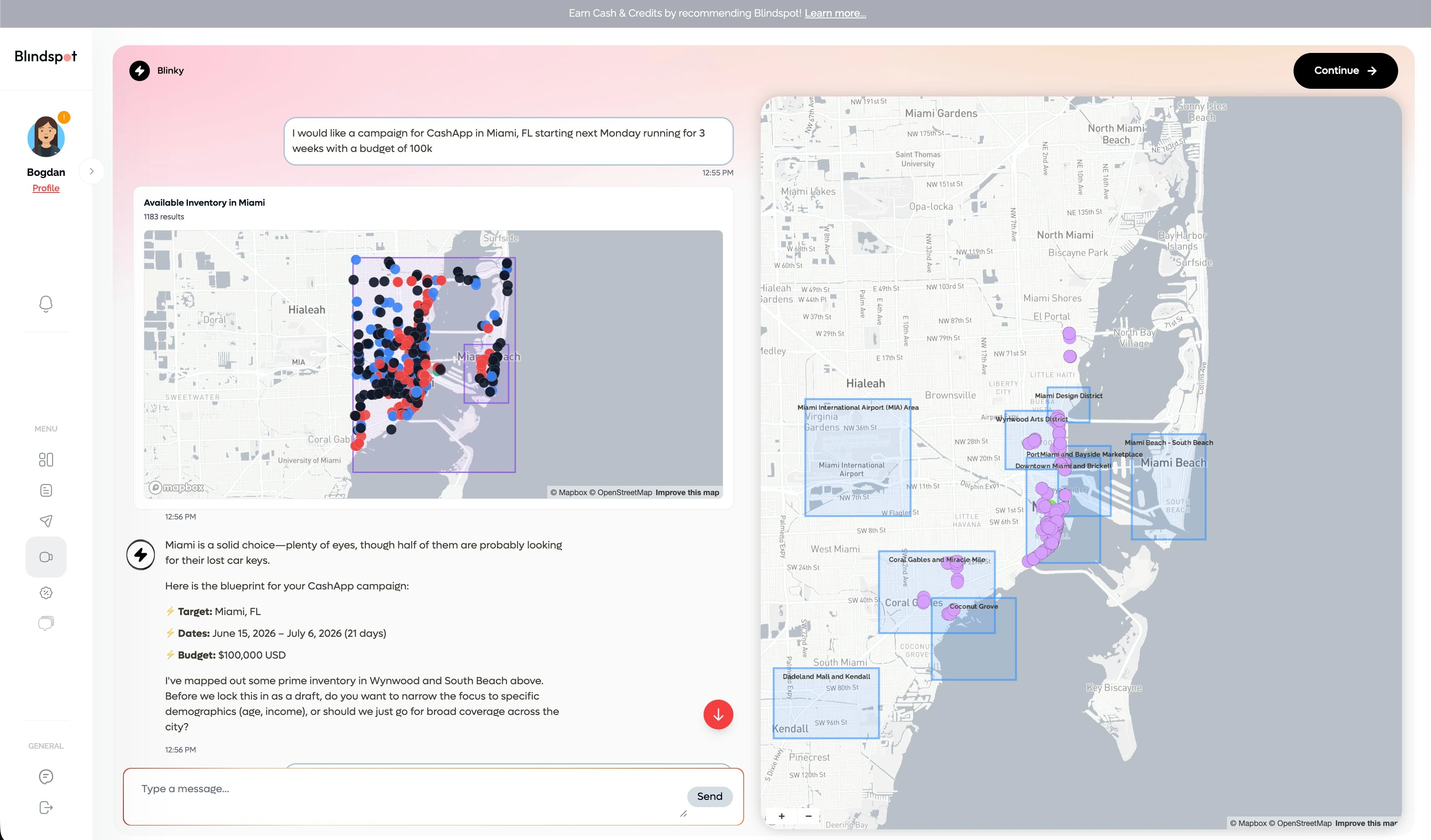
I would like a campaign for CashApp in Miami, FL starting next Monday, running for 3 weeks with a budget of 100k.
INVENTORY MAPPED · 1,183 SCREENS Miami is a solid choice — plenty of eyes, though half of them are probably looking for their lost car keys. I've mapped prime inventory in Wynwood and South Beach. Want to narrow to specific demographics, or go broad across the city?
Only outdoor units, only high-traffic hours. Focus on Brickell, Downtown and Wynwood — we're targeting entrepreneurs, founders and tech folks.
DRAFT LOCKED · MIAMI TAKEOVER Hitting Brickell, Downtown, and Wynwood exclusively during high-traffic hours — catching those founders before they've had too many espressos.
0outdoor screens
0impressions reach
Peak hrstraffic timing only
$0requested budget

How it works

Brief to billboard in five steps

No 40-slide deck, no three-week back-and-forth. This is the actual product — every screenshot below is the real interface.

Step 01 · The brief

Start like any chat. End with a campaign.

Tell Blinky what you want to advertise, where, and what your budget is. One phrase is enough — "new gym, Austin, $25K" works. The more detail the better: target audience profiles, specific days, specific hours.

Already have a full media brief? Upload it as a DOC or PDF and Blinky reads the whole thing.
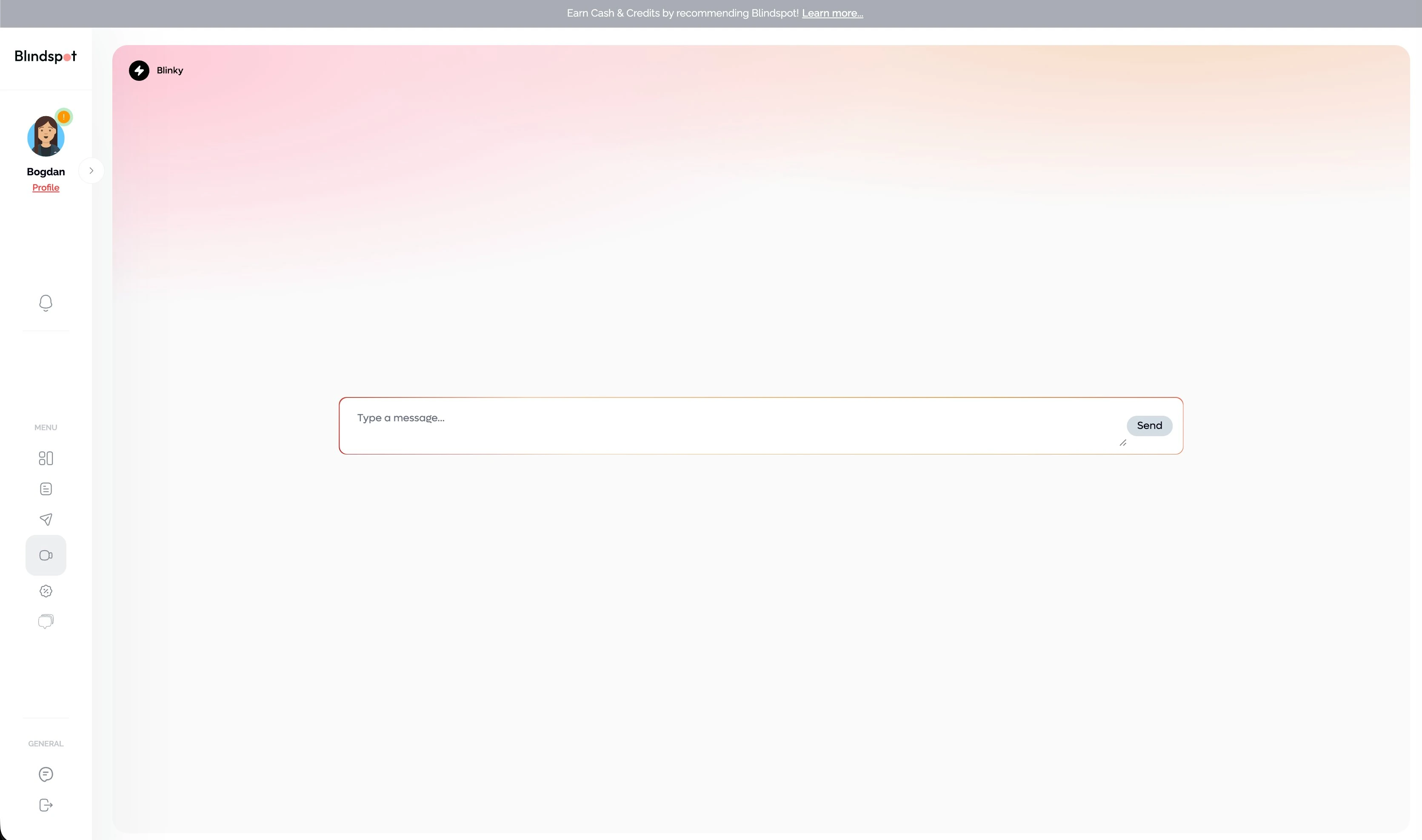
Blinky's chat interface in the Blindspot platform, waiting for a campaign brief to be typed
Step 1 · the brief — one sentence or a full PDFLive product
Step 02 · The homework

Blinky does the research you'd never have time for

Before picking a single screen, Blinky studies your brand — your website, your social media, how customers engage with your products — then dissects the brief to understand exactly who the campaign is targeting.

Then it goes to work on the world: available inventory in the most relevant areas — 1,183 screens mapped for one Miami brief — plus events that will move crowds and weather patterns that change where people walk. Over 7 million data points go into building each location's psychographic profile.

It's a conversation, not a black box. Blinky asks what success looks like — narrow to specific demographics or go broad? — and you can push it toward specific formats, locations, or a different market entirely.

  • Brand identity
  • Social engagement
  • Inventory
  • Live events
  • Weather
  • Footfall
  • Psychographics
Blinky mapping 1,183 available screens in Miami for a CashApp brief and asking whether to narrow the audience by demographics
Step 2 · 1,183 screens mapped from one brief7M+ data points
Step 03 · The map

Every screen on a map. Every number in view.

Blinky reveals the plan: the map, the screen selection, and the stats that matter — budget, number of units, impressions, dates. No surprises either: it shows what you asked for next to what full saturation would cost, so you decide.

Don't like something? Say so — or tap it: proceed to payment, adjust the budget, change the locations. Add screens, cut screens, shift the spend; Blinky replans in seconds. When it looks right, hit continue.
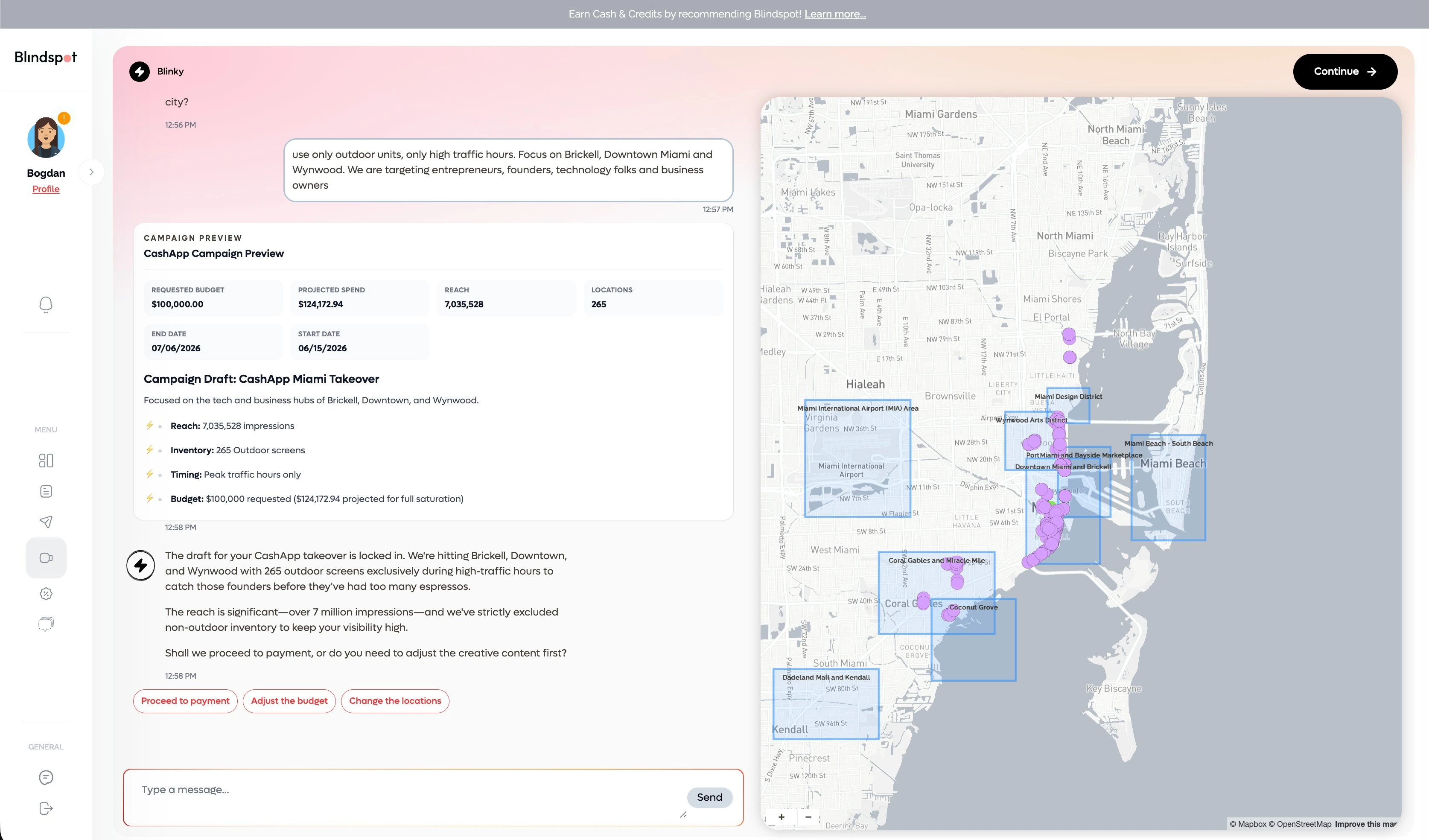
Blinky campaign preview for a Miami takeover: 265 locations, 7,035,528 reach, requested versus projected budget, map of selected zones, and one-tap actions to adjust budget or locations
Step 3 · one brief later: 265 screens, 7M reachEditable live
Step 04 · The campaign

The full overview — and the media handled

The complete picture: campaign details, a heat map of when your media runs and on how many units, the map, and the schedule groups (more on those below — they're the part nobody else has).

Media is handled here too. Upload everything in one go — Blinky automatically assigns each creative to the right format. Set contextual rules, customize what each schedule group runs and when, or tell Blinky to rework any group's schedule entirely.
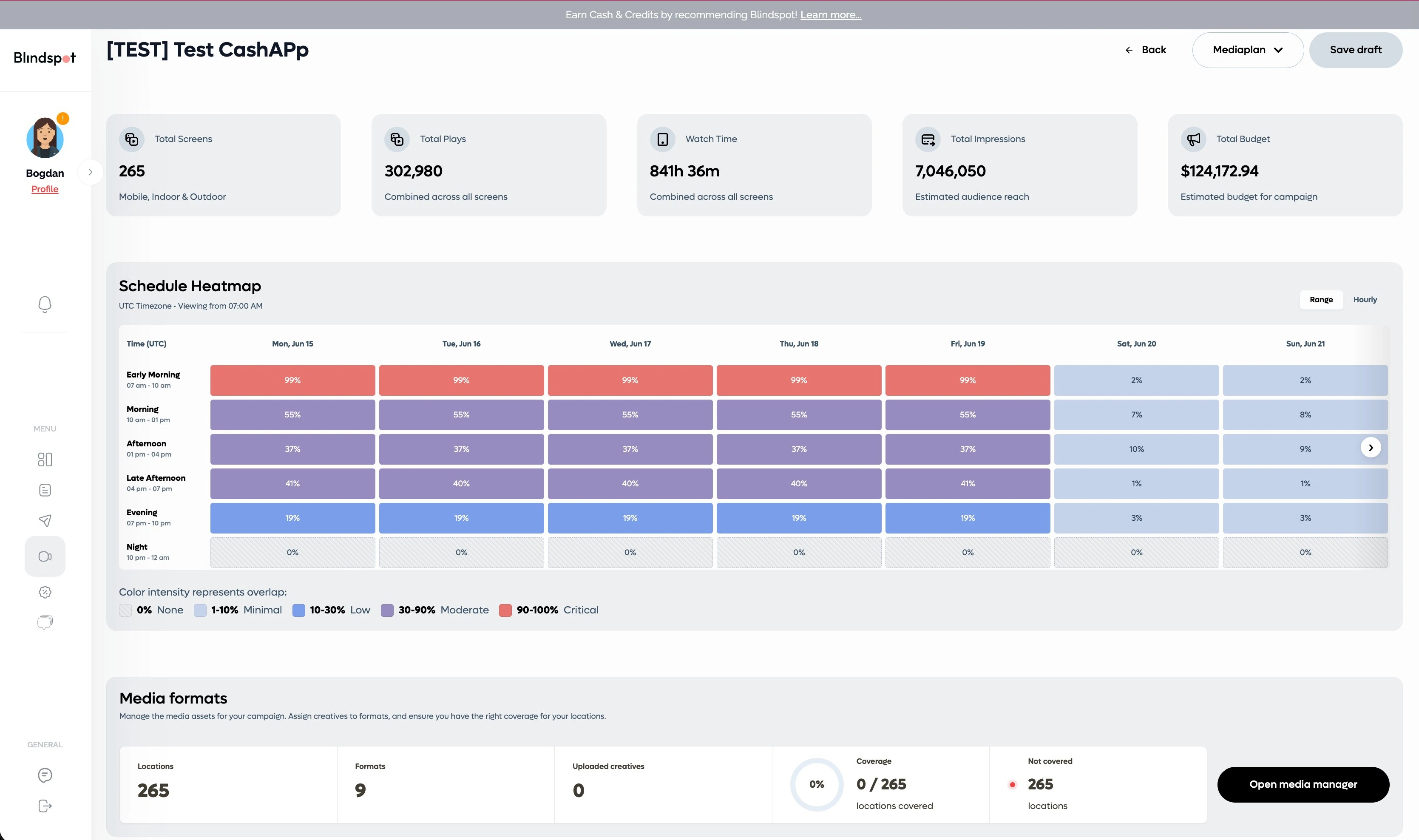
Blinky campaign overview: 265 screens, 302,980 plays, 7,046,050 estimated impressions, schedule heat map by daypart and day, and media format coverage
Step 4 · overview, heat map & media formatsFull control
Step 05 · Live

Publish — then Blinky stands guard

Save, publish, done. But Blinky doesn't clock out: it oversees the campaign for the entire flight, making sure it delivers as planned.

If a screen drops, Blinky finds alternatives automatically. Your campaign keeps running; you keep sleeping.
Start your brief

Flight watch · always onBlinky
DeliveryMonitored play-by-play, all flight long
Screen dropsReplaced automatically with alternatives
Conditions changeSchedules adapt — events, weather, traffic
Your jobApprove once. That's it.

The differentiator

One campaign. Many clocks.

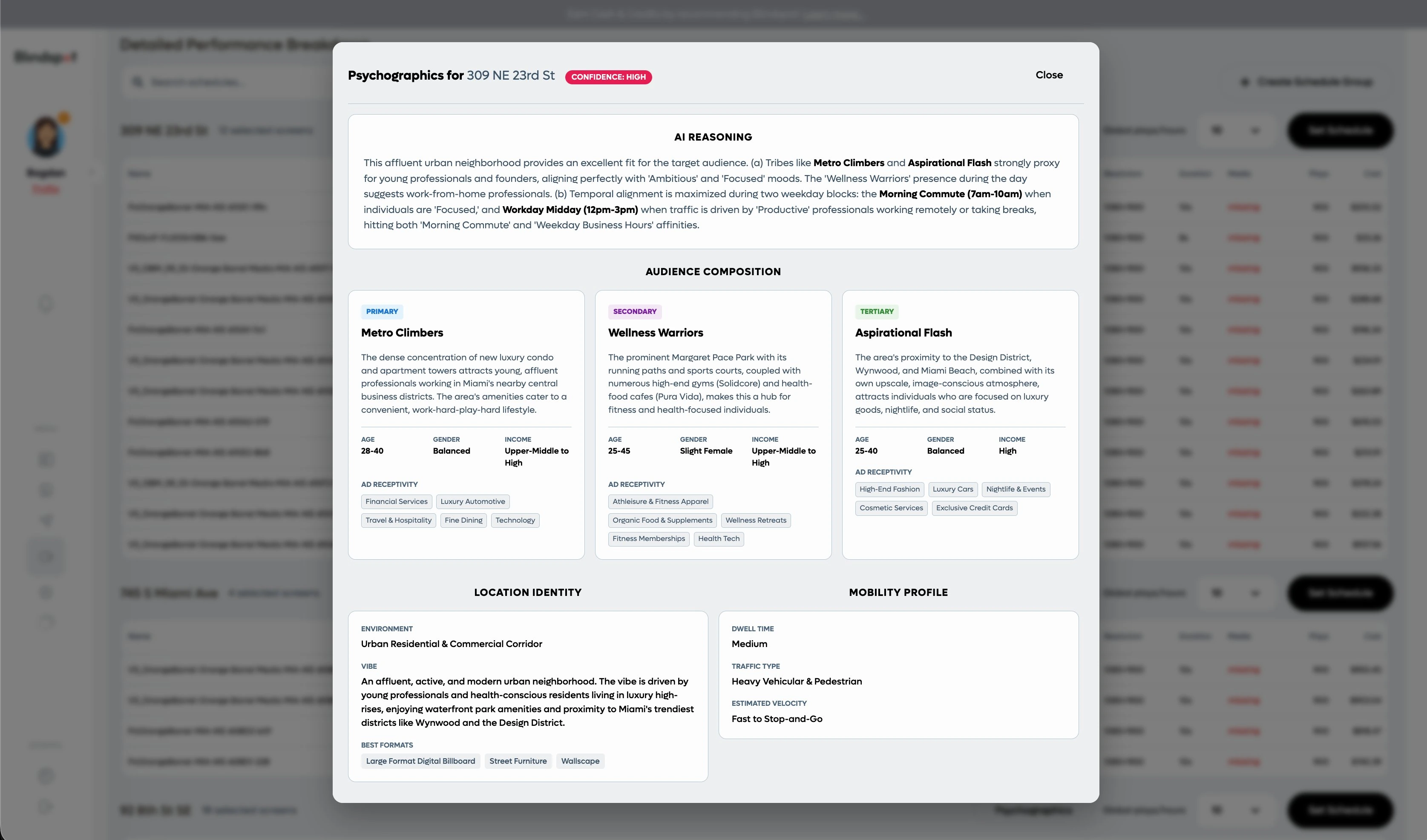
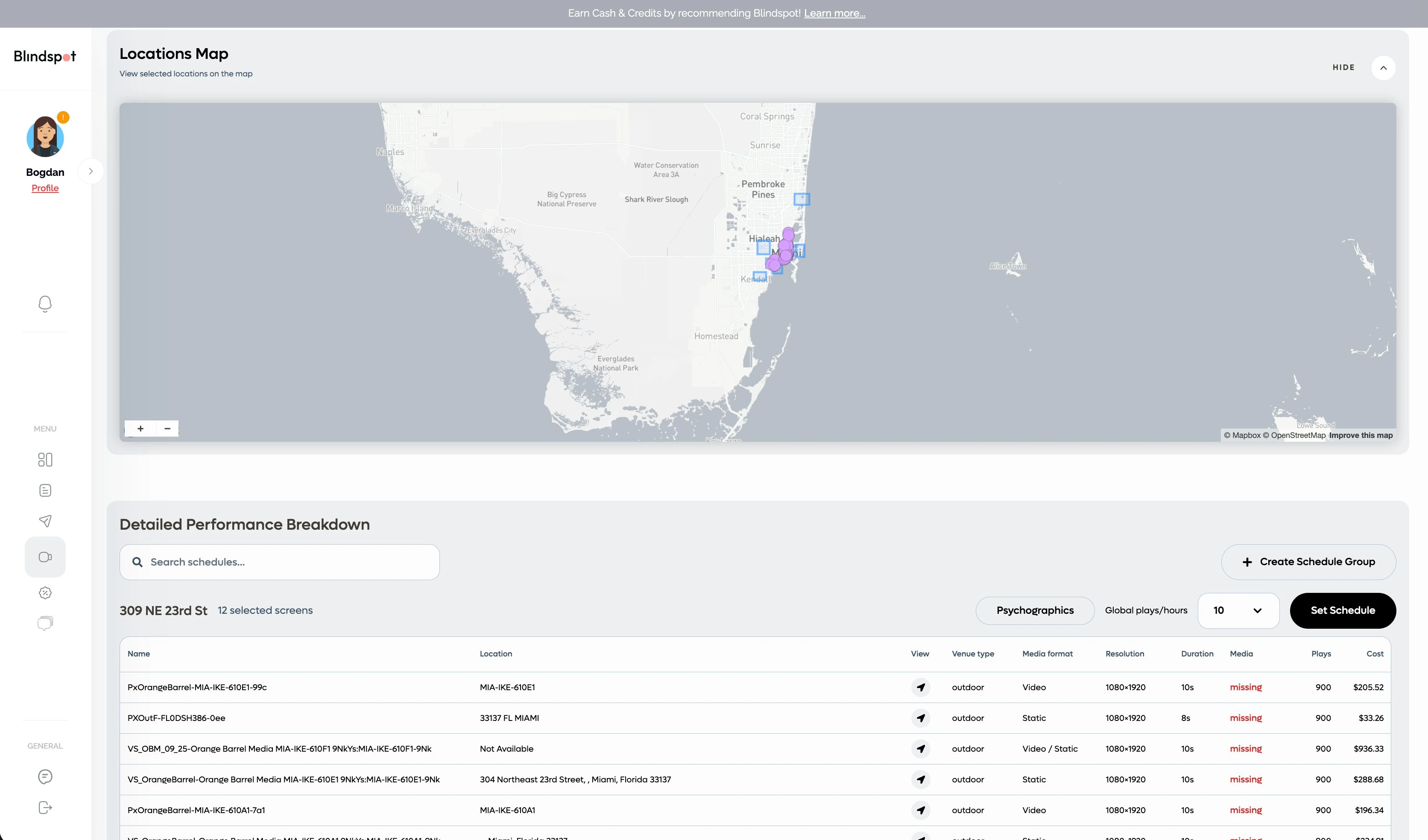
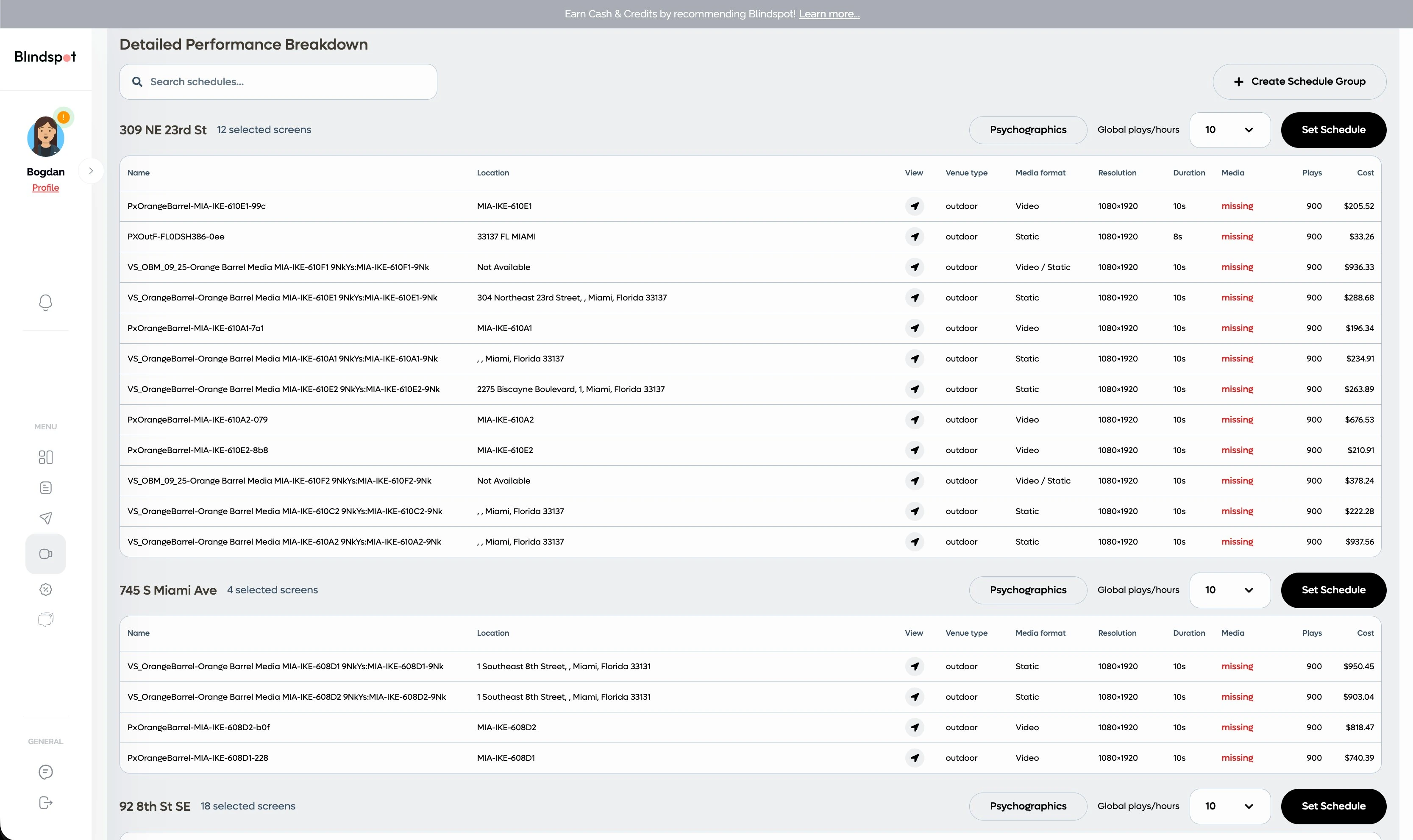
Blinky doesn't build a single flat media plan, because a city doesn't move as one crowd. People flow differently through a station at 8 AM than past a mall at 8 PM — so Blinky clusters your screens into schedule groups, each with its own audience, its own identity, and its own unique schedule correlated with data from GPS companies, social media, and event platforms. In the Miami plan above that means groups like 309 NE 23rd St (12 screens) or 745 S Miami Ave (4 screens) — and each one ships with its AI reasoning written out in plain English, so you can read exactly why those screens earned those hours.

Per group

Psychographic profile

Named audience tribes — Metro Climbers, Wellness Warriors, Aspirational Flash — with age, gender, income, and what ads they're actually receptive to.

Per group

Location identity

What this cluster is: environment, vibe, and best formats — "urban residential & commercial corridor," large-format digital, wallscape.

Per group

Golden hours

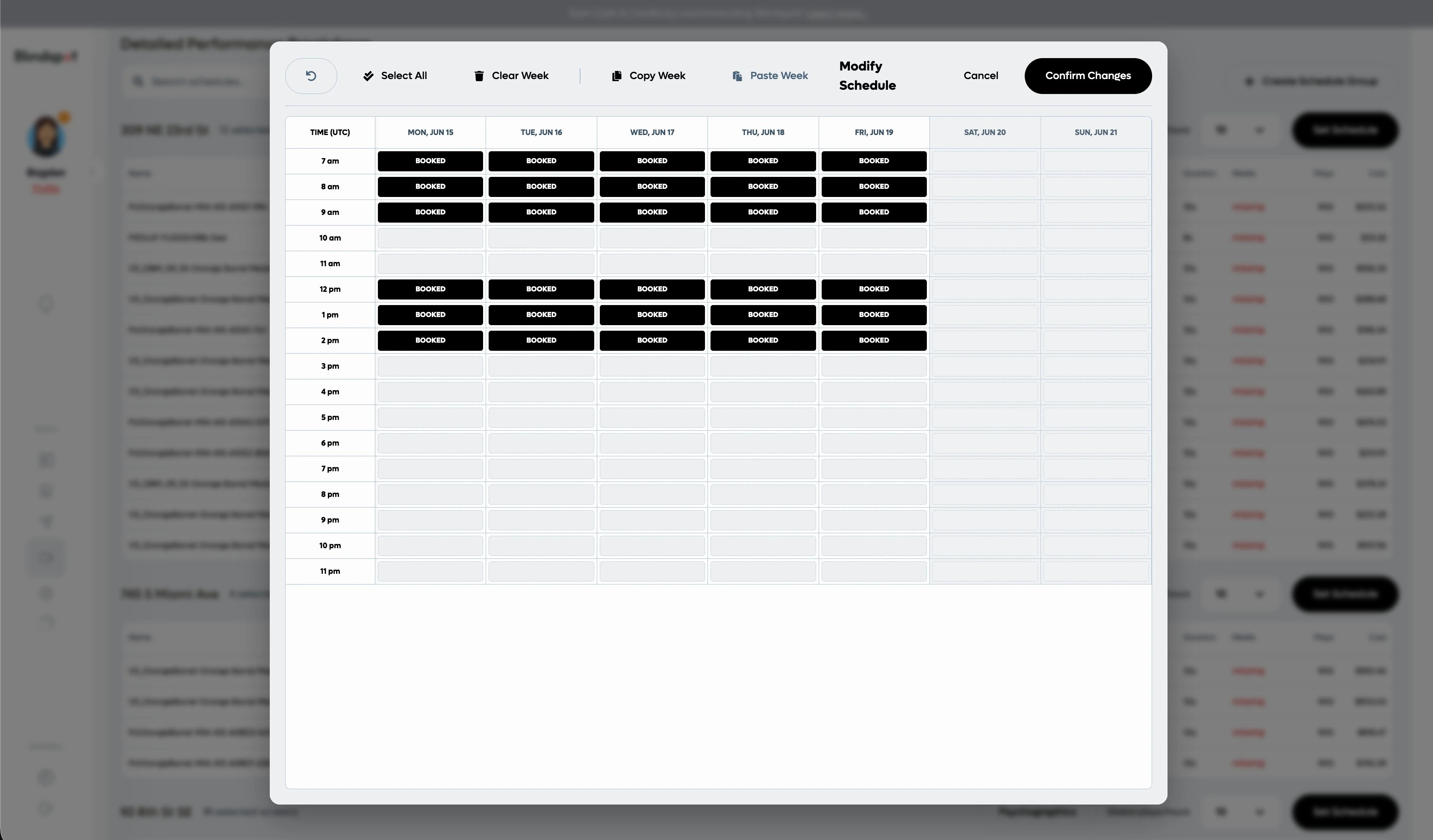
The hours when this exact audience peaks — Morning Commute 7–10 AM, Workday Midday 12–3 PM — the only hours worth paying for.

Per group

Temporal insights

Dwell time, traffic type, estimated velocity — how the flow shifts by day and daypart, so the schedule bends with the city.

Locations map of a Blinky campaign showing clustered screens across Miami above the detailed per-screen performance breakdown
The clusters on the map — every screen accounted forPer-group targeting
Blinky schedule groups named by location — 309 NE 23rd St with 12 screens, 745 S Miami Ave with 4 — each with per-screen format, resolution, plays, and cost
Groups by location · per-screen plays & costAuto-clustered
Psychographics panel for the 309 NE 23rd St group: plain-English AI reasoning, audience tribes Metro Climbers, Wellness Warriors and Aspirational Flash with age, income and ad receptivity, location identity, and mobility profile
Psychographics · AI reasoning, tribes & receptivityConfidence: high
A schedule group's weekly grid with hours booked only at golden hours — weekday mornings 7 to 10 AM and midday 12 to 3 PM — with copy week and modify controls
The group's week · booked only at golden hoursHour by hour

Receipts, not promises

The night Blinky found Billie Eilish

Planning a campaign for Intimissimi, Blinky spotted a Billie Eilish concert in downtown Miami — an audience of mostly young women, the brand's exact customer profile, with an Intimissimi store in Brickell a short walk from the arena.

Concert play · MiamiIntimissimi × Blinky
SignalBillie Eilish concert, downtown Miami
Audience matchMostly young women — the exact customer profile
Schedule2 hours before doors + 2 hours after — full capture
Store proximityIntimissimi Brickell, near the arena
ResultStore sales significantly up over the following days

That's the philosophy: attribution tells us DOOH works — planning makes sure it doesn't. We wrote about it in The Drum, and the full story is in the Intimissimi case study.

Why it wins

A typical buy vs a Blinky plan

Typical OOH / pDOOH buyBlinky plan
GoalDrive the average CPM downMaximize conversions and ROI
SchedulingContent runs 24/7, audience or notGolden hours per schedule group — only when your audience is there
Inventory logicCheapest available screensScreens earn their spot with footfall, events, and psychographic fit
During the flightSet and forget; drops go unnoticedBlinky monitors delivery and replaces dropped screens automatically
Budget outcomeSpend it all, hope for the best30%+ saved — reinvest in share of voice or more screens

The savings aren't a discount — they're waste that never gets bought. Hours your audience isn't there, screens they don't pass. Blinky simply refuses to pay for them.

Key facts at a glance

Quotable, self-contained, sourced — Blindspot, June 2026

  • Blinky is Blindspot's agentic AI media planner for digital out-of-home: it analyzes the brief and brand, builds a screen-by-screen plan across 3,000,000+ screens in 50+ countries, books it, and oversees delivery.
  • Each plan is built on over 7 million data points — live events, weather, traffic, footfall, and brand/social signals — clustered into schedule groups with psychographic profiles and golden-hour scheduling.
  • Briefs can be a single sentence or an uploaded DOC/PDF media brief; the user can edit screens, schedules, markets, and contextual creative rules at every step before publishing.
  • Blinky optimizes for conversions and ROI, not low average CPMs — clients typically save 30%+ versus a traditional OOH or pDOOH buy, reinvestable in share of voice or screen count.
  • Blinky is free to use; advertisers pay only their media budget. If a screen drops mid-flight, Blinky replaces it automatically.

Questions

Blinky, explained

What is Blinky?

Blindspot's AI media planner for digital out-of-home. Unlike a chatbot that gives advice, Blinky is agentic: it analyzes your brand and brief, checks over 7 million data points, builds a screen-by-screen and hour-by-hour plan across 3 million+ billboards, books it into your account, and oversees delivery once live.

How much does Blinky cost?

Nothing. You pay only your campaign media budget — no planner fee, no agency markup, no minimums. And the plans themselves typically save 30%+ versus a traditional buy.

What do I need to give it?

What you're advertising, where, and your budget. One sentence works; a full media brief uploaded as DOC or PDF works better. Add audience profiles, days, or dayparts if you have them — Blinky asks follow-ups to fill any gaps.

Can I edit the plan?

At every step. Swap formats, change markets or DMAs, add or cut specific screens, rework any schedule group's timing, set contextual rules for which creative runs when. Nothing goes live until you approve and publish.

What are schedule groups?

Blinky's signature move. Instead of one flat plan, it clusters screens by how people actually flow through the city — each group gets its own psychographic profile, audience composition, location identity, golden hours, and a unique schedule correlated with GPS, social, and event data.

What happens after launch?

Blinky oversees the whole flight. If a screen drops out, it finds and books alternatives automatically so delivery never stalls.

How is it different from other planning tools?

Most tools chase cheap average CPMs and run content 24/7. Blinky optimizes for conversions: it runs your content only when your audience is actually in front of the screen — like scheduling around a concert your exact customers attend. That discipline is where the 30%+ savings come from.

Keep exploring

See Blinky's work in the wild

Every campaign below ran on the same platform Blinky plans into — verified plays, real results.

Your move

Give Blinky one sentence

That's all it takes. Brief in, plan out, live on real billboards — free to plan, pay only for the media.