The definitive guide · updated June 2026
Digital Out-of-Home (DOOH) advertising is any digital billboard or screen used for advertising in real-world environments — and programmatic buying has turned it from a $50,000 handshake business into a checkout. Here's the whole picture.
The definition
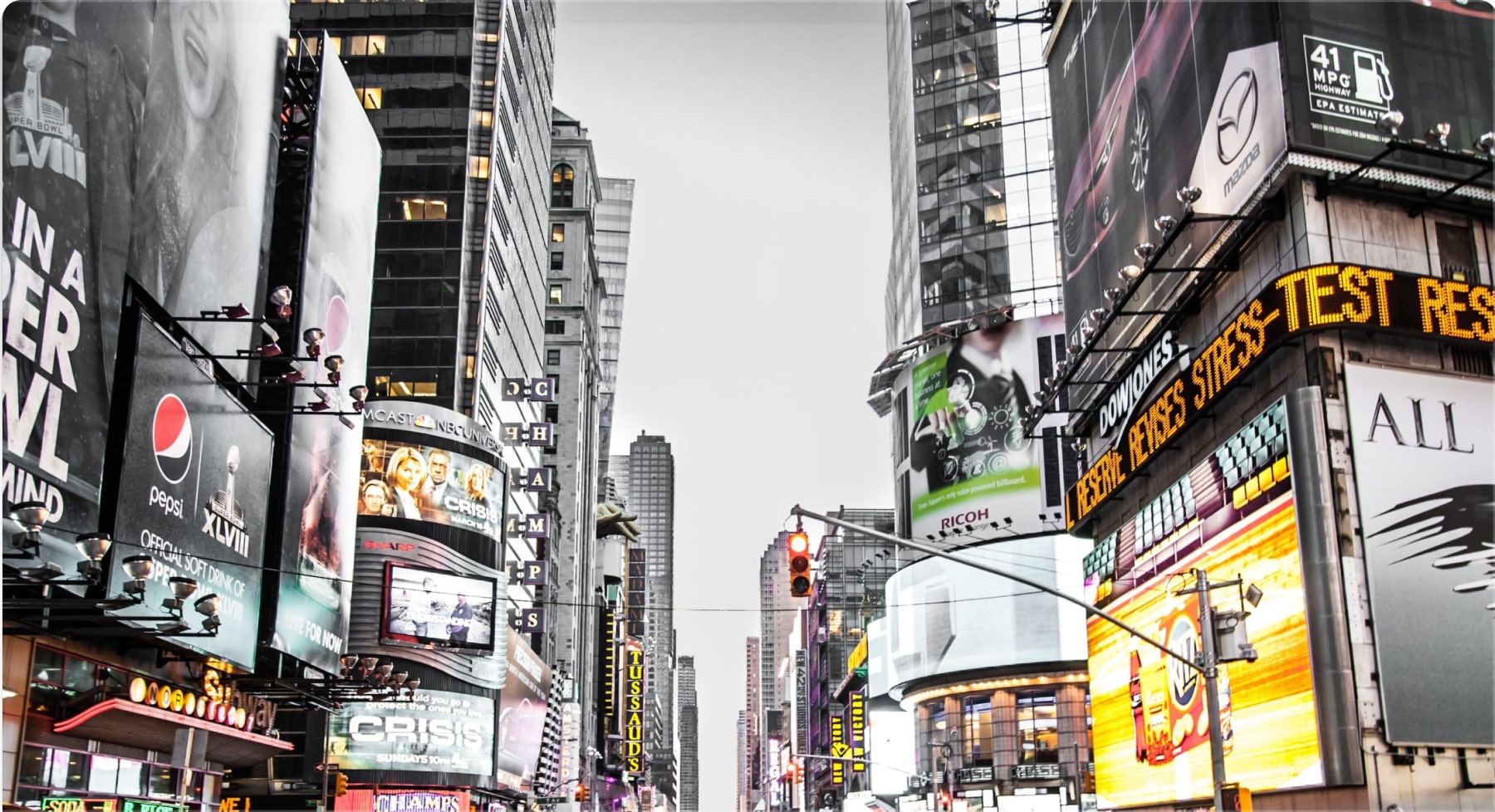
Digital Out-of-Home (DOOH) encompasses any digital billboard or screen used for outdoor or indoor advertising — large-format urban billboards, transit and airport screens, retail displays, and venue screens. It is one of the fastest-growing channels in advertising because it pairs the unskippable physical presence of a billboard with the targeting, flexibility, and measurement of digital media.
A brief history: the word "billboard" dates to 1845 — any board where public "bills" were posted. Classic OOH meant static prints in airports, on highways, and along city streets. DOOH replaced the paper with pixels: high-resolution screens, motion video, and interactive layers like touchscreens, NFC, and mobile integration — in shopping centers, bus shelters, office buildings, and the most famous squares on earth.
Why it matters now: creative changes in real time on triggers like weather, traffic, time of day, or live events. Targeting runs on mobile movement data and programmatic delivery — no third-party cookies involved. And measurement finally matches online: verified plays, impressions, and attribution from foot traffic to sales. When budgets crashed 50% across traditional OOH during the pandemic (IAB), programmatic DOOH grew — because it could adapt overnight.
The method
Effective DOOH comes down to three decisions. Content: 92% of adults consume multiple media simultaneously (IPA TouchPoints), so a billboard should rhyme with your digital campaigns, not repeat them — one story across the street and the feed. Context: audiences see DOOH on the move, so the message should match the moment — weather-triggered creative selling cold drinks on hot days measurably outperforms static messaging. Screen: a freeway-facing large format builds reach; a screen inside a pub at 6 PM builds intimacy. Match the format to the job.
The programmatic unlock: platforms like Blindspot removed the gatekeepers. Any business can launch a micro-campaign with transparent hourly pricing and zero contracts — test a market for the cost of a team lunch, read the data, then scale what works. The same checkout reaches 3M+ screens in 50+ countries.
Tracking results: modern DOOH reports verified ad plays and estimated impressions in real time, plus attribution that online marketers recognize — foot-traffic lift, web-traffic lift, and sales measured against control groups. Blindspot's measured campaigns include Intimissimi's +53.5% store-visit lift and UiPath's +104% web-traffic lift.
Go deeper
Costs, locations, and receipts — the practical layer on top of this guide.
Real ranges by format and city, plus a budget calculator.
Read → The playThe status-arbitrage playbook on the most famous screens on earth.
Read → The proofFoot traffic, web lift, and sales — receipts, not promises.
Read →